Accessing Support
The following content was adapted from an article titled “Premenstrual dysphoric disorder causes debilitating periods. Here’s what we know about how to treat it.”, published in The Conversation, used under Creative Commons License. Read the full article »
Living with PMDD can feel overwhelming, especially when it comes to deciding on treatment. There is no single approach that works for everyone. Many people find that the most effective care combines medical treatments, therapy, and lifestyle strategies.
Treatments that have performed well in quality, randomized controlled trials have the strongest evidence for effectiveness in treating PMDD. They require a prescription so it’s necessary to work with a health-care provider. They include:
Antidepressants
Selective serotonin re-uptake inhibitors (SSRIs) are effective for approximately 60 per cent of PMDD patients. They may help with emotional or psychological symptoms. For some, SSRIs also help with physical symptoms such as bloating or breast tenderness.
The SSRIs fluoxetine, sertraline and paroxetine are first-line treatments for PMDD. These medications reduce symptoms faster in PMDD than in other mood or anxiety disorders. There are several ways to take SSRIs to treat PMDD: taking SSRIs continuously, only during the luteal phase or with the onset of symptoms.
Discuss SSRI dosages with a health-care provider. Trying SSRIs for two to three menstrual cycles is ideal to gauge effects in reducing symptoms. If SSRIs do not work, serotonin-norpinephrine re-uptake inhibitors (SNRIs) could be another antidepressant option. But SNRIs include a higher risk of side effects, so be sure discuss this with a provider.
Birth control pills
Most oral contraceptive (birth control) pills are not effective to treat PMDD because taking hormone pills for 21 days and switching to sugar pills for seven days creates hormone fluctuations that can trigger PMDD symptoms.
However, a specific type — drospirenone-containing oral contraceptive pills (DCOCs) — can help reduce PMDD symptoms. Dropsirenone is a unique synthetic progestin that is not found in other birth control pills.
Taking DCOCs continuously (skipping sugar pills) or following a 24-4 regimen (24 days of hormone and four days of sugar pills) is recommended for PMDD. This regimen helps suppress ovulation better and eliminates hormone fluctuations seen in the luteal phase. It reduces the chances of a negative brain response to hormone changes.
Examples of DCOCs include the brands Yaz, Angeliq, Beyaz, Gianvi, Loryna, Nikki, Ocella, Syeda, Vestura, Yaela, Yasmin, Zarah. Yaz is approved by the U.S. Food and Drug Administration for PMDD treatment.
Other treatment options
Gonadotropin-releasing hormone analogues (GnRHa, aka chemical menopause) creates a temporary, reversible menopausal state. It prevents the release of hormones that trigger ovulation. This in turn eliminates hormone fluctuations that trigger PMDD symptoms.
Hormone replacement therapy (HRT) using ethinyl estradiol and synthetic progestin is often used with GnRHa treatment to reduce side effects such as hot flashes, night sweats and loss of bone density. It helps preserve heart and brain health. Introducing HRT may lead to an initial resurgence of PMDD symptoms, but these often subside once hormone levels are stable.
Accessing GnRHa and HRT can be difficult due to limited expertise. Using GnRHa beyond six months is a new treatment and needs supervision from a gynecologist, or sometimes a psychiatrist with expertise in reproductive mental health. If doctors are unsure about prescribing long-term GnRHa, there are provider-specific resources. It can help start the discussion around GnRHa treatment.
Ovary removal with or without hysterectomy (surgical menopause) is a last-line treatment for PMDD. This is a surgical procedure that removes ovaries and fallopian tubes, or ovaries, fallopian tubes and the uterus. It is invasive and irreversible. It also requires replacing hormones via HRT.
Many women with PMDD are intolerant to progesterone. Removal of the uterus can help some to stay on estrogen-only HRT. Patients would need to discuss these possibilities with a gynecologist. Consider surgical menopause only if all other treatments have failed to reduce PMDD symptoms.
Potential treatments needing more research
Some people with PMDD do not experience relief with SSRIs or DCOCs. There are other medical options that show promise for PMDD symptoms, but they need more research to understand their effectiveness.
The use of 5a-reductase inhibitors such as dutasteride and finasteride can help. They prevent the formation and flux of progesterone metabolites in the brain. They are approved to treat conditions like benign prostatic hyperplasia in men, but are an “off-label” treatment for PMDD. Only a few providers may be willing to prescribe 5a-reductase inhibitors for PMDD as it can cause adverse effects.
Mood stabilizers such as quetiapine in the luteal phase along with an SSRI can help PMDD, especially for those who did not benefit from taking only SSRIs.
Taking continuous estradiol plus progesterone is another option. This treatment uses natural formulations of estradiol and progesterone that are less potent than synthetic birth control pills.
This means that ovulation suppression may be inconsistent and dosages would need adjustments. If ovulation is not suppressed, it could trigger PMDD symptoms, so patients need careful monitoring and supervision from a health-care provider.
Non-medical treatments
Cognitive behavioural therapy (CBT) and dialectical behavioral therapy (DBT) can help with PMDD symptoms. They involve learning techniques to manage thoughts and emotions. DBT can also help cope with strong emotions and suicidal thoughts.
Additionally, self-care skills can lay the foundation for healthy habits. This includes lifestyle changes like maintaining sleep health and adopting physical activity.
Ensuring adequate rest during premenstrual weeks helps manage symptoms. Reducing alcohol use, managing stress and eating a balanced diet can also help in managing symptoms.
Anecdotally, some PMDD patients swear by supplements but more research is needed to understand their effectiveness. For example, PMDD symptoms may improve when using vitex agnus castus. But effects of using calcium carbonate and vitamin B6 for PMDD are unclear.
Supplement intake is risky because they are not well-regulated. Talking to a health-care provider will help in addressing unique health situations.
Challenges in identifying treatment options
PMDD symptoms are unique to each person. Tracking symptoms while trying new treatments can help shed light on how treatment is affecting PMDD symptoms. Likewise, tracking symptoms while making lifestyle changes can show which ones are helping.
Because PMDD was only recently recognized, many health-care providers may also be new to understanding PMDD and its treatment. PMDD treatment needs to be a partnership between the provider and the patient, each learning from the other.
Additional Resources
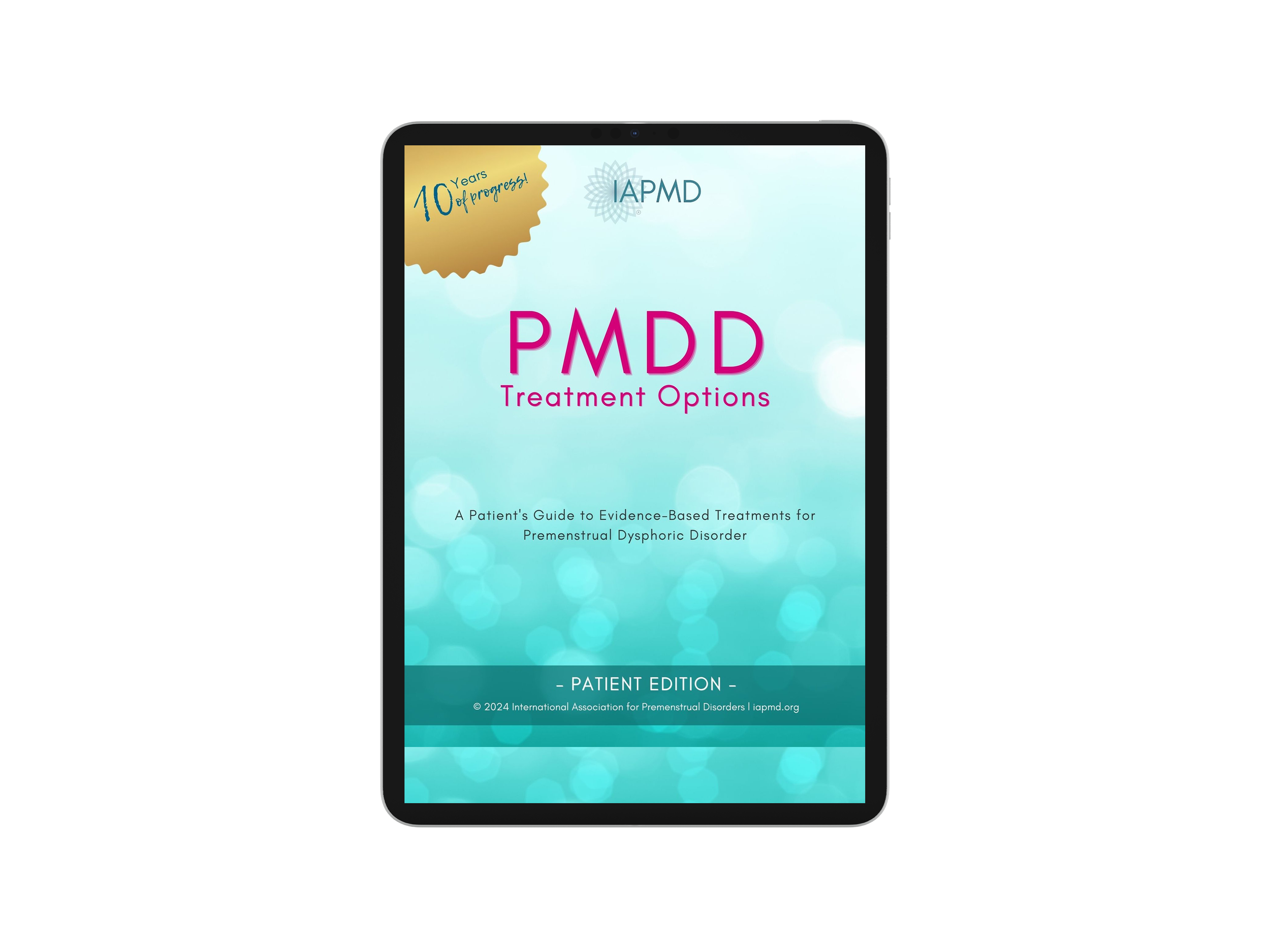
IAPMD PMDD Treatment Options eBook
Sale Price:
$19.99
Original Price:
$25.99
ON SALE FOR MENTAL HEALTH AWARENESS MONTH
“If you are new to PMDD or want to learn more about PMDD, this is the book for you!”
“Amazing resource! As a mental health counselor, I am always seeking trustworthy resources to provide to my patients. I am so glad to add this to my library.”
—
A Patient’s Guide to Evidence-Based Treatment for Premenstrual Dysphoric Disorder by Team IAPMD
Combining up-to-date research with clinical expertise and patient experience, this is your guide to PMDD treatment. PMDD Treatment Options provides you with evidence-based information, empowering you to confidently navigate your treatment and care!
*100% of your purchase supports the work of IAPMD to provide support, information, and resources to those living with premenstrual disorders.
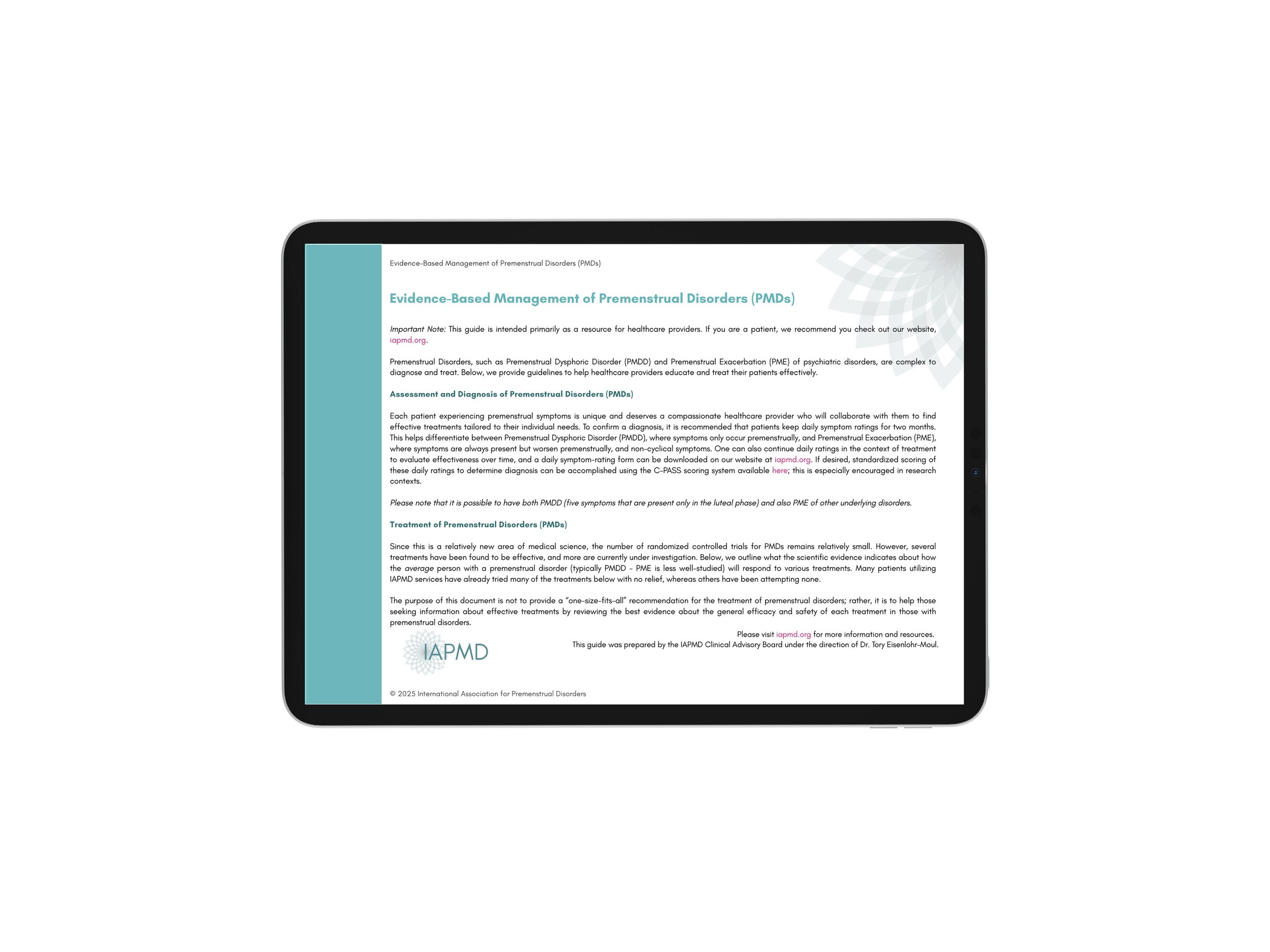
FREE IAPMD Premenstrual Disorders (PMDs) Treatment Guidelines
$0.00
Treatment for Premenstrual Dysphoric Disorder (PMDD) and Premenstrual Exacerbation (PME) can be complex and highly individual, but you are not alone. At IAPMD, we combine up-to-date research, clinical expertise, and lived experience to guide patients, caregivers, and providers through the treatment journey.
Our evidence-based Treatment Guidelines, developed by IAPMD’s Clinical Advisory Board, offer expert-reviewed recommendations for medical, therapeutic, and lifestyle interventions. These free resources support informed decision-making and compassionate care for PMDD and PME.
Looking for a deeper dive? Our comprehensive eBook, IAPMD PMDD Treatment Options, provides additional clinical insights and tools to help you better understand your options and confidently navigate care.
Whether you’re a patient, caregiver, or healthcare provider, these resources are here to empower you.